32 million rows. One pass. Zero credits.

Strike the junk.
Keep the leads.

Carrier-filtered, de-duplicated and verified on your own machine — before a single paid lookup is spent.

List Viper — PinkViper Labs
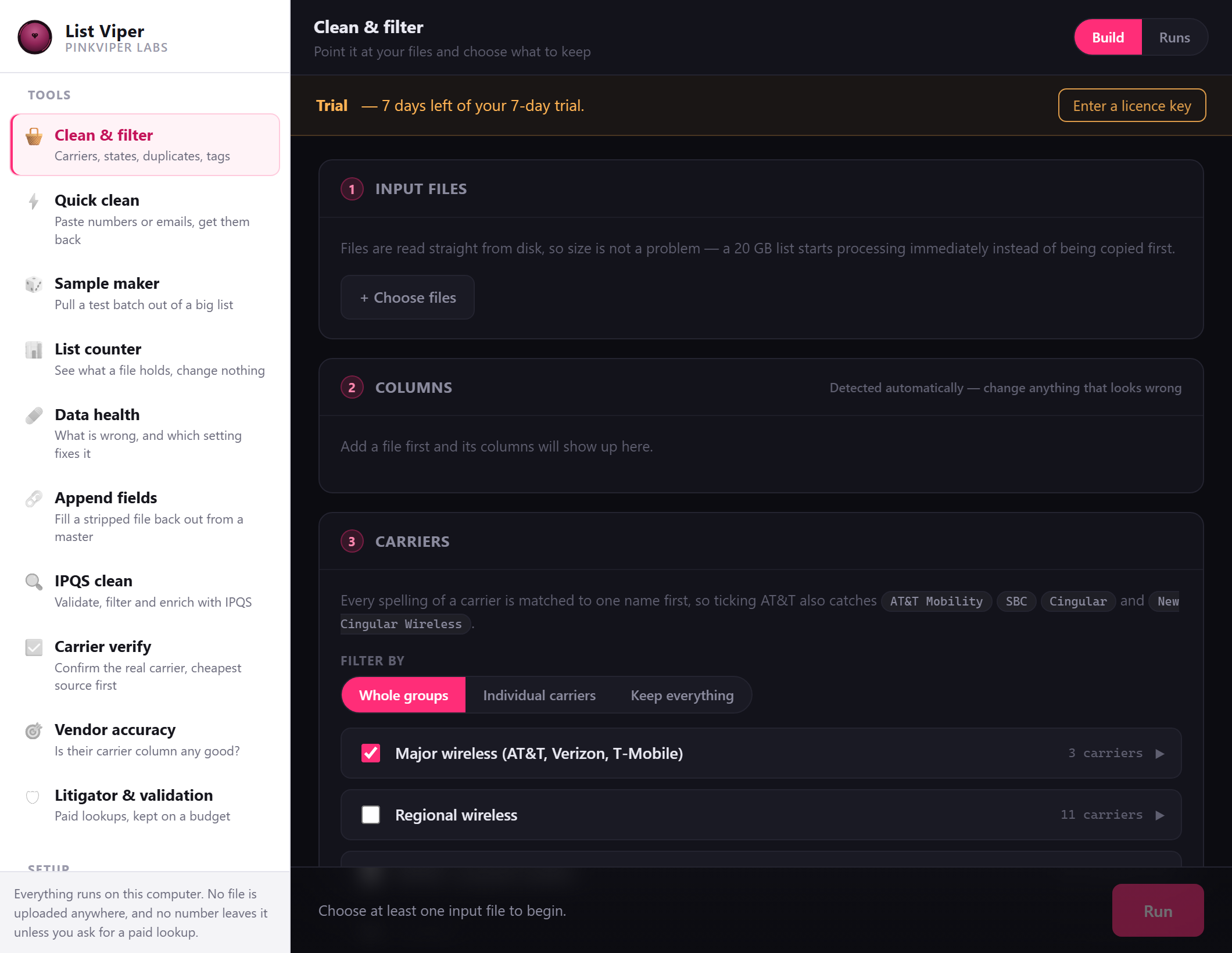
List Viper running on Windows: the tool list down the left, and the carrier
                filter with whole groups for major wireless, regional wireless, MVNO, landline
                and VoIP.
The actual application. No mock-up.
list-viper — clean & filter LIVE
0
Rows in
0
Junk struck
0
Clean out
$0
Spent doing it
The method

Nothing costs a cent
until everything free has failed.

Most tools validate first and filter after — so you pay to check numbers you were always going to bin. List Viper runs it backwards. Four free layers strip the list down, and only the survivors ever reach a billable lookup.

Malformed free
0rows in
De-duplicated free
0exact — one bit per number
Block table free
0landline & VoIP struck
Your cache free
0answered free, already owned
01

A block table that costs nothing

Two million prefixes from the public numbering plan, compiled into a flat 20 MB array. Line type resolves in one indexed read. No network, no per-row fee, no ceiling.

02

De-duplication that cannot lie

One bit per possible number, allocated lazily. Exact rather than hashed — it can never produce a false match — and flat in memory whether the file is 20 MB or 20 GB.

03

A cache that compounds

Every answer you buy is kept for good. Lists overlap month to month, so the second run over the same data is mostly free and the tenth is almost entirely free.

564 files · 3.5 GB
The toolkit

Fifteen tools.
One window.

22.3%
of a real 32-million-row list — 7,151,542 rows — struck before a single credit was spent.
Measured, not claimed

Built for files that
crash spreadsheets.

0
Carrier lookups per second against the block table. A 32-million-row list resolves in about five minutes.
0+
Rows per second through the full clean-and-filter pipeline, memory flat regardless of file size.
20 GB
Read straight off disk by path. Never copied, never uploaded, never held in memory whole.
Validation IPQualityScoreLine type, carrier, active status, do-not-call and fraud score — capped before it starts.
Compliance Blacklist AllianceTCPA litigator and known-plaintiff scrubbing, on a budget you set in advance.
Free forever NANPAThe public numbering plan. Two million prefixes, refreshed quarterly, costs nothing.
Pricing

Buy it once.
Keep it for good.

Buy once
Solo
$497once
Yours for good — 12 months of updates included
  • One machine, no expiry, ever
  • All fifteen tools, no row limits
  • The two-million-prefix block table
  • Your verification cache, kept for good
  • A year of updates and support
Buy Solo — $497 or run the 7-day trial first — no card
Agency
$997once
Five machines — 12 months of updates included
  • Five seats, no expiry, ever
  • Everything in Solo
  • Priority support
  • Help importing your existing lists
  • Carrier alias additions on request
Buy Agency — $997 or run the 7-day trial first — no card
Enterprise
Talkto us
Volume, multi-site, custom data
  • Unlimited seats
  • Custom carrier data feeds
  • LRN / portability layer
  • Response-time commitment
  • Onboarding for your team
Get in touch
No subscription. The software never stops working. After twelve months you keep everything you have — updates are $197 a year if you want the newer versions. Every plan starts with a 7-day trial, 250,000 rows a run, no card.
One 32-million-row file. $157,000 of lookups not bought.

That file had 7,151,542 rows of landline, VoIP and duplicates struck out before a single credit was spent. At the $0.022 a lookup the validation services charge, that is what one run saved. The Solo licence costs less than one per cent of the savings from that single run — and you own it afterwards.

Questions

The things people
ask first.

How do I remove landlines and VoIP numbers from a phone list?

Import the free NANPA block table — a few seconds on first run — then untick Landline and VoIP under Carriers and run Clean & filter. The table covers over two million NPA‑NXX prefixes and gives you the line type of every number without a single paid lookup. On a real 209-million-row archive it identified roughly a third of the surviving numbers as landline or VoIP.

Do I have to pay for a carrier lookup on every number?

No, and avoiding that is the point of the tool. Carrier resolution runs in four steps, cheapest first: your own verified cache, then the free block table, then the vendor’s carrier column if the file came with one, and only then a paid lookup — on distinct numbers only, and only on what survived every free filter above. Every paid answer is cached forever, so the same number is never bought twice.

How large a file can it handle?

There is no size limit. Files are streamed from disk rather than loaded into memory, so memory stays flat as the file grows. The largest measured run was 209,024,147 rows across 208 files and 26 GB, finished in a single pass in about two hours on an external USB drive.

Does my data get uploaded anywhere?

No. Your lists are read off your disk and written back to it — no upload, no account, no cloud storage. The only things that ever leave the machine are a phone number when you ask to buy a lookup for it, and a once-daily licence check-in carrying a licence ID, an anonymous machine fingerprint and a version number. No names, no lists, no rows.

How do you de-duplicate 200 million phone numbers without running out of memory?

By storing one bit per possible number instead of the numbers themselves. A set holding a hundred million numbers would want north of 6 GB; a bitmap indexed by phone number, allocated lazily in blocks, stays close to a gigabyte however long the file is.

Is the carrier data accurate given number portability?

The block table is reliable for line type — wireless, landline, VoIP — and only approximate for brand, because porting moves a number between carriers without changing the block it was issued from. Use it to strike landlines and VoIP with confidence. For verified brand, use the cache or a paid lookup; every output carries a carrier_source column so a verified answer is never confused with a block-table guess.

Which validation services does it work with?

Two, and they are separate accounts with separate billing. IPQualityScore for phone validation, line status, prepaid, do-not-call, abuse history and fraud score. Blacklist Alliance for litigator scrub against known TCPA litigators and serial filers. Both are inert until you enter your own API key, and neither can spend the other’s balance.

What file formats does it read?

CSV, TXT or any delimited text. Comma, tab, pipe and semicolon delimiters are detected automatically, as are UTF‑8, UTF‑8 with BOM, Windows‑1252 and Latin‑1 encodings. The phone column is found by the shape of the numbers rather than the header text, so unlabelled columns still work.

Is it a subscription?

No. $497 once for one machine, $997 for five. The licence is perpetual and the software never stops working. Twelve months of updates are included; after that the version you have carries on exactly as it is, and newer versions are optional at $197 a year.

Does it run on Mac or Linux?

Not currently. List Viper is a Windows application, tested on Windows 10 and Windows 11. It installs for you alone and needs no administrator rights.

Get it

Seven days.
No card. No account.

Download List Viper

Windows installer, 21 MB. Installs for you alone — no admin rights needed. Full product for seven days, 250,000 rows a run.

Download for Windows →
What it takes
Files
CSV, TXT, or any delimited text — no size limit
Delimiters
Comma, tab, pipe or semicolon, detected for you
Encodings
UTF‑8, UTF‑8 BOM, Windows‑1252, Latin‑1
Phone column
Found by the shape of the numbers, not the header — unlabelled columns still work
Largest tested
32,131,610 rows in one pass
version 1.0.3
SHA-256 f22e86115ebd533977feab36d0aded7560c493137262a43244fddcf3a33c8011

Ready to buy?

Pay once and it is yours for good. Card, bank, Cash App, Klarna or Amazon Pay. Your licence key is emailed to you the moment the payment clears — instantly on a card, and the day it settles if you pay by bank.

New to it? Read the manual — every tool, the carrier method, and what to do when a file misbehaves.
1Download and run the trial on your own data.
2Pay above and give the name for the licence.
3Paste the key into Licence — the limits lift immediately.
Enterprise, volume or a question first? jade@pinkviperlabs.com
Signed by Pinkviper LLC. Windows shows that name when you run the installer — if it says anything else, it is not our file. The certificate is issued through Microsoft’s code-signing service, and the SHA‑256 above lets you check the download yourself.

Windows may still show a “Windows protected your PC” box for a short while after a new certificate is issued, until it has been seen enough times. If it does, click More info — the publisher will read Pinkviper LLC, which is the thing worth checking.

Your data never leaves
this computer.

No upload. No account. No cloud bucket. No telemetry. Your lists are read off your disk and written back to it, and nothing else ever sees them.

Two things do leave, and it is worth saying exactly what. A phone number, when you ask to buy a lookup for it — that is the lookup. And once a day, a licensed copy reports its licence ID, an anonymous machine fingerprint and the version number, so a key that was refunded or passed around can be switched off. No names, no lists, no rows. If that report never gets through, nothing stops working — the licence is verified offline by signature, and the check-in is only ever advisory.

See the method →